

The 5-year metastasis-free survival rate was 75% with trimodality therapy vs 74% with radical cystectomy.
The 5-year metastasis-free survival rate was 75% with trimodality therapy vs 74% with radical cystectomy.

Increasing numbers of older patients with cancer necessitates adoption of an age-friendly approach to cancer care.
Press Release
"With intravesical chemotherapy, there aren't the side effects we see with intravenous chemotherapy because the drugs only treat the bladder lining and very little, if any, of the medicine gets absorbed in the bloodstream," said Nitin Yerram, MD.
The theranostic 64Cu/67Cu SAR-bisPSMA yielded positive safety and efficacy signals in patients with metastatic castration-resistant prostate cancer.

"We believe that more thorough body weight control in childhood could serve as a preventive measure for preserving testicular function in adulthood," says Rosella Cannarella, MD, PhD.

"At 1 month, there was a clinically significant improvement in SHIM scoring in men that did receive the treatment vs the sham arm, which didn't," says Jeunice Owens-Walton, MD.
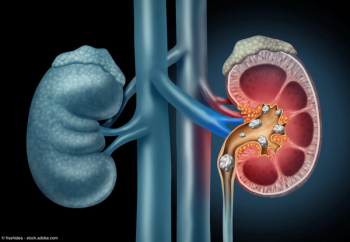
The trial assessed outcomes in patients who had kidney stones between 1 to 2 cm.

"I’m frank with them. If it’s something I haven’t heard of, I tell them. I also tell them where I get my information," says Kevin Krughoff, MD.

The data were presented at the recent American Urological Association Annual Meeting.
Trajectory inference analysis pointed to SIX2+CITED1+ as the nephrogenic cancer stem cells at the origin of Wilms tumor.

While online reviews are critical in any industry, patient expectations are simply different when it comes to health care.
“These results validate the clinical value of bone biomarker assessment in the HSPC state," state the authors.

Press Release
Men with high-risk prostate cancer who received immunotherapy treatment with enoblituzumab in the weeks leading up to surgery had favorable rates of disease remission and tumor downgrading after surgery.
Bradley Gill, MD, MS, recaps several presentations on benign prostatic hyperplasia from the 2023 American Urological Association Annual Meeting in Chicago, Illinois.
"A couple [of] times recently, I’ve done 6 in 1 day. A couple weeks ago, I did 4, the week before that, 5. So I would say I’ve seen an uptick," says urologist Bradford Black, MD.

The findings held even when the investigators adjusted for age, past medical history, smoking status, and type of surgery.
Katie S. Murray, DO, recaps several presentations on bladder cancer from the 2023 American Urological Association Annual Meeting in Chicago, Illinois.
Kelly L. Stratton, MD, FACS, recaps several presentations on prostate cancer from the 2023 American Urological Association Annual Meeting in Chicago, Illinois.

The study also found a positive correlation between burnout and discrimination-based trauma in trainees.

Here’s how the specialty fared vs other eligible clinicians.

Implementing the right practice technology can not only mitigate physician burnout, it can also enable patients to take charge of their own care experience.
Jen-Jane Liu, MD, discusses how PSMA-PET imaging might help physicians decide whether or not a patient with prostate cancer needs lymph node dissection.
In the study, 69% of patients who underwent complete ablation had no visible disease at first endoscopic evaluation, compared with 40% of patients who underwent chemoablation therapy.

Of all malignant bladder cancer lesions, 28% were only identified with blue light.
Patients who underwent sacrocolpopexy and were discharged on post-op day 0 had fewer instances of readmissions and fewer high-grade (class III-IV) complications.

Researchers examined the impact of deep learning–based AI software upon radiologists reviewing multiparametric MRI scans in the assessment of clinically significant prostate cancer.
"This institute model will lower barriers for access to some of the highest quality care in the world,” says Alexander Kutikov, MD, FACS.

"The good news is that women have been entering medicine in increasing numbers for more than three decades. The not-so-good news is that women are still underrepresented and underutilized in positions of power," writes Deborah M. Shlian, MD, MBA.
Press Release
“The medication is given once a week for 6 weeks. It is an outpatient procedure with general anesthesia. And it is typically covered by insurance,” said Joseph Brito, MD.
"What was great about this partnership is we recognized that this is going to be the future of medicine at some point, and we want to be able to be a part of that cutting edge technology," says Nitin K. Yerram, MD.