

"This scope allowed me to maintain the intrarenal pressures lower than I would originally have done," says Naeem Bhojani, MD, FRCSC.
"This scope allowed me to maintain the intrarenal pressures lower than I would originally have done," says Naeem Bhojani, MD, FRCSC.
“I am seeing this process rapidly expand, particularly with the use of the single-port robot, which offers additional benefits to things like pain control and helps to further expedite early discharge,” Andrew Wood, MD.

“There are a couple of nomograms that are good for predicting either T2 or higher disease at time of surgery, so on final pathology, or T3 or higher,” says Suzanne Lange, MD.

The patient presented with a large right renal mass who elected for right radical nephrectomy with possible inferior vena cava.
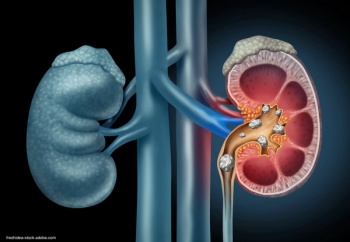
"The biggest take-home message for any urologist who's treating kidney stones is to understand that what we consider to be success may not be what our patients consider to be success," says John Michael DiBianco, MD.
"Before you even start your contract negotiation, I think it's really important to have a negotiation with yourself and understand what's important to you," says Siobhan M. Hartigan, MD.

“I would just burn it into everyone's brain that pain with intercourse is also going to be associated with genitourinary syndrome of menopause,” says Rachel Pope, MD, MPH.
Closing out his review of imaging modalities in the setting of prostate cancer, Brian Helfand, MD, PhD, looks toward future evolutions in detection and treatment.
Expert perspective on next steps for physicians and patients following a negative imaging result when recurrent prostate cancer is suspected.
Moving on to the second patient case of prostate cancer, Brian Helfand, MD, PhD, shares context for negative imaging results in this setting.
A brief discussion on how selection of imaging should be approached for patients receiving androgen deprivation therapy (ADT) for prostate cancer.
Following his review of available imaging modalities, Brian Helfand, MD, PhD, considers which scans are most appropriate based on patient and disease factors.
A comprehensive review of imaging modalities available to patients with prostate cancer who are suspected of recurrence.
Specialist Brian Helfand, MD, PhD, reviews the case of a 65-year-old man with prostate cancer and shares insight on strategies to monitor for recurrence.

"It may be something that practicing urologists could already start speaking to their patients about," says Siobhan Sutcliffe, PhD, ScM, MHS.
"It wasn't just about the salary number, but what other things are within the contract that could make a huge difference on your practice and your life," says Siobhan M. Hartigan, MD.

“We highlighted that there is building evidence suggesting clinical benefits for lymph node dissection, such as a clear benefit of staging, which allows us to perform better prognostication for patients,” says Suzanne Lange, MD.

"This has the opportunity to really revolutionize the way we treat kidney stone disease via ureteroscopy," says Naeem Bhojani, MD.

“First and foremost is that same-day discharge appears to be safe. There were no failure-to-rescue events within 24 to 48 hours after discharge outside of the hospital,” says Andrew Wood, MD.

"You have to manage and maintain the other parts of yourself that are not answering all those needs from work," says Jennifer M. Taylor, MD, MPH.

"What really surprised us was that 25% of our Botox cohort had previously undergone nerve stimulation, and those patients were less likely to stop Botox," says Katherine L. Woodburn, MD.

“There's a huge potential role for urologists out there for female sexual health,” says Rachel Pope, MD, MPH.

"We used data from this study to see whether having a greater number of flares independently impacted patients’ quality of life as well as their healthcare seeking activity," said Siobhan Sutcliffe, PhD, ScM, MHS.
“We thought anesthesia type would be relevant. But both urologists and patients determined that it actually was not relevant to their decision making,” says John Michael DiBianco, MD.

“It seems like podcasts really are a good way for people to learn about even a complex topic like this,” says Stacy Loeb, MD, MSc.
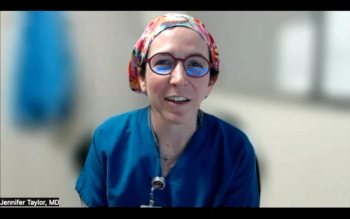
"The interesting thing that's come out of the research that Dr. Lebares has done is that burnout can be countered by mindfulness," said Jennifer M. Taylor, MD, MPH.

“These are add-on codes that need to be added on to the evaluation and management service that's done on that patient on that day,” says Jonathan Rubenstein, MD.

“In medicine, we're not taught the business of medicine, but the day that you become faculty at an institution or private practice, you learn that it is a business, but yet nowhere in our training are we taught that,” says Michelle Pearlman, MD.

"In many cases, we're now bringing the capabilities of the hospital into a patient's home," says Timothy D. Lyon, MD, FACS.

“There are just a lot of barriers, unfortunately, to speaking freely about women's sexual health,” says Rachel Pope, MD, MPH.