

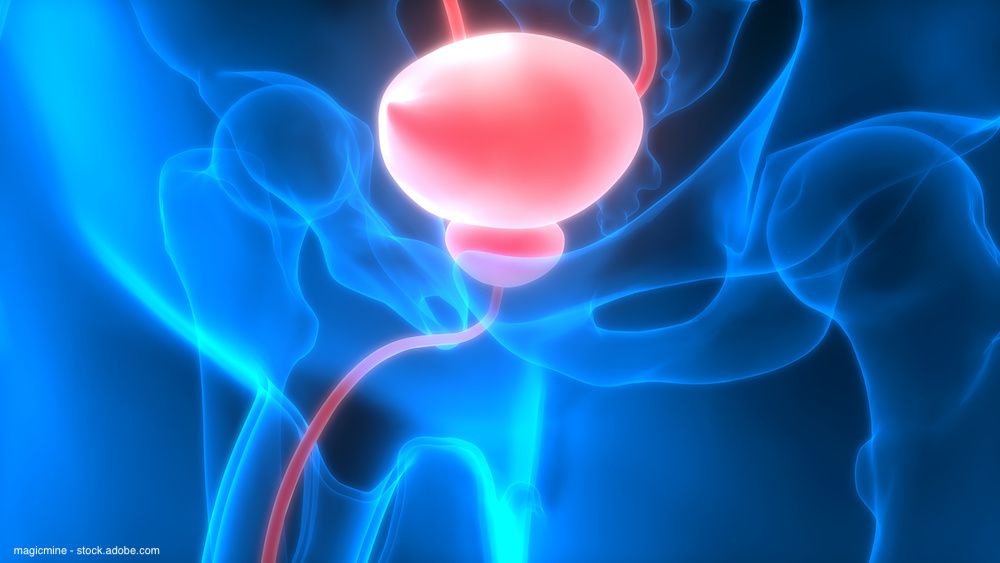




Bladder Cancer
Latest News
Advertisement
Latest Videos







CME Content


Advertisement
More News
Cabozantinib's single-agent activity opens the potential for combination approaches with immunotherapy in patients with heavily pretreated urothelial carcinoma.

BLC with hexaminolevulinate can be an easily replicable procedure in patients with non–muscle-invasive bladder cancer.

In this episode, Angela B. Smith, MD, MS, of UNC Lineberger Comprehensive Cancer Center, discusses the recent FDA approval of Jelmyto, which is the first therapy for the treatment of low-grade upper tract urothelial cancer.

The FDA has approved the PD-L1 inhibitor avelumab for the frontline maintenance treatment of patients with locally advanced or metastatic urothelial carcinoma.
The combination of the personalized cancer vaccine RO719845 and the PD-L1 inhibitor atezolizumab showed strong clinical activity across solid tumors, including bladder cancer and renal cell carcinoma.

Median overall survival is the same for both malignancies, study results show.
The dual biomarker of ARID1A mutations and CXCL13 expression was associated with improved overall survival in patients with advanced urothelial carcinoma.

Anti–PD-1/PD-L1 agents were associated with similar efficacy across pure and variant histologies in patients with advanced urothelial carcinoma, with the exception of those with a neuroendocrine variant.

Pembrolizumab has been granted a second tumor-agnostic FDA indication, this one for patients with solid tumors with a high tumor mutational burden.
Neoadjuvant pembrolizumab plus chemotherapy achieved a high rate of pathologic downstaging to noninvasive disease and was associated with a high radical cystectomy rate in cisplatin-eligible patients with urothelial cancer.

Avelumab (Bavencio) as a maintenance treatment after chemotherapy significantly extended overall survival in patients with advanced urothelial cancer, according to findings from thephase III JAVELIN Bladder 100 trial.

"In the era of BCG shortage, it would have been highly desirable to demonstrate the efficacy and safety of fewer BCG instillations for high-risk bladder cancer. However, reduced frequency of maintenance BCG instillations is associated with increased risk of cancer recurrence, albeit with fewer adverse effects," writes Badar M. Mian, MD.

The FDA approved an additional recommended dosage of 400 mg every 6 weeks for the anti-PD-1 therapy pembrolizumab (Keytruda), across all adult indications, including monotherapy and combination therapy, Merck reported.

Nadofaragene firadenovec, a novel intravesical gene-mediated therapy, achieved complete response in 53.4% of patients with bacillus Calmette Guérin-unresponsive carcinoma in situ, according to findings from a phase III trial. First author Stephen A. Boorjian, MD, professor of urology at Mayo Clinic, Rochester, MN, discusses the study results and their implications.

Systemic and intravesical therapies are changing the landscape of BCG-unresponsive disease, according to Matthew Galsky, MD.

New results from a study investigating infigratinib in patients having metastatic urothelial carcinoma with activating FGFR3 mutations and/or fusions indicate that the investigational selective fibroblast growth factor receptor 1 to 3 (FGFR1-3) tyrosine kinase inhibitor may have greater activity for treating upper tract urothelial carcinoma than for urothelial carcinoma of the bladder.

Durvalumab (IMFINZI) appears to be feasible as neoadjuvant therapy with preliminary evidence of antitumor activity in patients with muscle-invasive bladder cancer who are ineligible for cisplatin-based chemotherapy.

ImmunityBio announced that the FDA has granted Breakthrough Therapy designation for its interleukin-15 agonist complex, N-803, in combination with Bacillus Calmette-Guerin (BCG), for the treatment of patients with BCG-unresponsive nonmuscle-invasive bladder carcinoma in situ.

The FDA has granted Breakthrough Therapy designation for enfortumab vedotin-ejfv (PADCEV) in combination with the anti-PD-1 therapy pembrolizumab (KEYTRUDA) for the treatment of patients with unresectable locally advanced or metastatic urothelial cancer who are unable to receive cisplatin-based chemotherapy in the first-line setting.

High-grade nonmuscle-invasive bladder cancer is characterized by high rates of disease progression following introduction of bladder-preservation therapy after treatment with Bacillus Calmette-Guérin.
“Histologic subtype shouldn’t exclude patients from getting checkpoint inhibitor therapy,” says Natalie J. Miller, MD, PhD.

"In this era of BCG shortage, we may be forced to develop new standards and alternative strategies for bladder preservation," writes Badar M. Mian, MD.
"It certainly looks like these new therapies will provide better results. From the research and literature, it looks like significant improvement," says one urologist.

“Our study showed that at least with the regimen used in our trial, patients can have chemotherapy in addition to radiotherapy without any fear that it will impair their quality of life,” says researcher Robert A. Huddart, MD, PhD.

“In the OLYMPUS trial, more than half of patients receiving the gel had complete regression of their cancers, and most of the responses were durable. Based on these results, if UGN-101 is approved, it can be strongly considered as a kidney-sparing option for a challenging cancer," says John L. Gore, MD, MS.
Advertisement
Advertisement
Trending on Urology Times
1
AI-generated profiles impersonate female urologists to market ED products online
2
Alternative BCG strains may help address ongoing supply challenges in NMIBC
3
Doublet or triplet? Urologists weighs in on mCSPC options
4
Pearls & Perspectives: Sexual Health and Intimacy in Midlife, With Karen Bigman, MBA
5