




Next-Generation Imaging
Latest News
Advertisement
Latest Videos


CME Content



Advertisement
More News

“PSMA scanning is definitely a game-changer with regard to imaging in advanced prostate cancer in urology,” says Evan R. Goldfischer, MD.
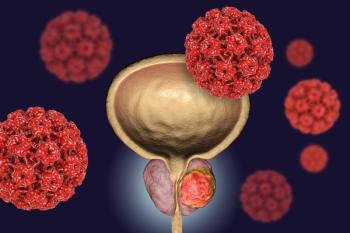
177Lu-PSMA-617 is approved by the FDA for the treatment of patients with PSMA-positive metastatic castration-resistant prostate cancer in the post androgen receptor pathway inhibition, post taxane-based chemotherapy setting.

The co-primary end points have been achieved in the phase 3 ZIRCON trial exploring the novel PET imaging radiopharmaceutical TLX250-CDx in clear cell renal cell carcinoma.

64Cu SAR-Bombesin targets the Gastrin Releasing Peptide receptor, which is found on prostate tumors as well as several other tumors.
"During treatment with 177Lu-PSMA-617, patients should be counseled to increase oral fluid intake and to void frequently to reduce bladder radiation exposure," writes Stephanie Trexler, PharmD, BCOP.

New findings from the phase 3 SPOTLIGHT trial show the impact of PSA level, PSA doubling time, Gleason score, and prior therapy on 18F-rhPSMA-7.3 detection rates.
A recent study suggests that radiomics analysis based on 68Ga-PSMA-11 PET may non-invasively predict intraprostatic lesions in patients with prostate cancer.

Illuccix is indicated for use in patients with suspected metastasis who are candidates for initial definitive therapy, or in patients with suspected recurrence based on elevated PSA level.

“I think that we’re going to see more and more advances in how we use mpMRI from a pre-treatment planning perspective,” William P. Parker, MD.
The target of 64Cu SAR-Bombesin is the Gastrin Releasing Peptide receptor, which is found on prostate tumors as well as several other tumors.
“From a screening perspective, mpMRI really has changed how we evaluate men at risk for prostate cancer. It has improved the selection of men for biopsy and certainly improved our diagnostic rates,” says William P. Parker, MD.

Press Release
"HP 13C MRI provides a quick five-minute, non-radioactive, metabolic imaging add-on exam to standard-of-care MRI that, in conjunction with guided biopsies, has great potential to improve the care of prostate cancer patients,” said Robert Bok, MD, PhD.

The application is supported by findings from a phase 1 trial and two phase 3 trials, SPOTLIGHT and LIGHTHOUSE.

The phase 2 ProstACT TARGET study is exploring TLX591 (177Lu-DOTA-rosopatamab) in combination with external beam radiation therapy.
William P. Parker, MD, highlights 3 areas in which he thinks PSMA-PET imaging is going to be explored further in prostate cancer.
There are 2 FDA-approved PSMA-PET imaging agents: Gallium 68 PSMA-11 (Ga 68 PSMA-11) and piflufolastat F 18.
In this interview, William P. Parker, MD, highlights the development of PSMA-PET imaging in prostate cancer, FDA-approved PSMA-PET agents, and the next steps with this disruptive technique.

“PSMA-PET imaging is something that from a clinical practice perspective is rapidly changing and evolving the field of prostate cancer,” says William P. Parker, MD.
The target of 64Cu SAR-Bombesin is the Gastrin Releasing Peptide receptor, which is found on prostate tumors as well as several other tumors.

Experts weigh in on whether the combined technologies could be the future power couple of prostate cancer diagnosis.

The novel PET imaging agent 68GA-EMP-100 PET measures c-MET expression in renal cell carcinoma.
The PROPELLER trial is exploring the novel PSMA-PET imaging product 64Cu-SAR-bisPSMA in patients with treatment-naïve, histologically confirmed prostate cancer who are scheduled for radical prostatectomy

The phase 3 ZIRCON trial is assessing TLX250-CDx as a noninvasive tool to identify clear cell renal cell carcinoma in patients with indeterminate renal masses

177Lu-PSMA-617 is FDA-approved for the treatment of patients with PSMA-positive metastatic castration-resistant prostate cancer.
177Lu-PSMA-617 is approved by the FDA for previously treated patients with PSMA-positive metastatic castration-resistant prostate cancer.
Advertisement
Advertisement
Trending on Urology Times
1
CHMP recommends perioperative enfortumab vedotin plus pembrolizumab for MIBC
2
FDA grants RMAT designation to EG110A for neurogenic detrusor overactivity
3
FAQs: The 2026 AUA Guideline on Medical Management of Kidney Stones
4
Topical sildenafil cream associated with lower systemic exposure vs oral sildenafil
5