
"In recent years, lawmakers in several states considered legislation to conform their laws and exceptions to those outlined in the Stark law," writes the AACU's Ross E. Weber.
"In recent years, lawmakers in several states considered legislation to conform their laws and exceptions to those outlined in the Stark law," writes the AACU's Ross E. Weber.
This article examines current developments in robotic urologic surgery and future directions, including the introduction of alternative surgical robots.
James Lifton, MBA, a public (non-physician) director of the American Board of Medical Specialties, shares his observations from the recent American Board of Urology Examination Committee meeting.
A new study suggests that metallic Resonance ureteral stents are a good option for management of malignant ureteral obstruction because they promote strong long-term outcomes.
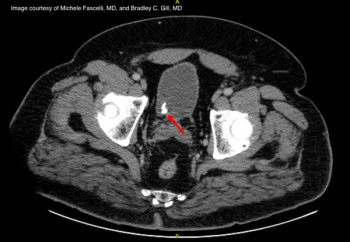
An elderly male with hypertension, lumbar spinal stenosis, morbid obesity, and ED presents with acute right-sided worsening of his chronic back pain. A distal right ureteral stone is found on CT and his symptoms respond well to medical therapy, but he later develops severe right flank pain.
In this "Coding Q&A" column, Ray Painter, MD, and Mark Painter also answer questions regarding bladder instillations and penile modeling during IPP placement.
"Given the costs of defense and the challenge to defend lawsuits involving [retained surgical items], preventing them from occurring at all is the best solution," writes Brianne Goodwin, JD, RN.
Enhanced Recovery After Surgery, or ERAS, is radically changing and standardizing preoperative, perioperative, and postoperative approaches to major surgeries, including radical cystectomy. And while the changes can seem troublesome at first, urologic surgeons who perform radical cystectomy say letting go of dogma is worth it for patients, physicians, and staff.
If the Medicare Payment Advisory Commission has its way with Congress, urologists and other Medicare providers will be subjected to a new payment system, replacing the Merit-based Incentive Payment System that was established when the sustainable growth rate formula was ditched in 2015.
An emergency fund is an important part of any financial plan and can be the difference between comfortably surviving an unexpected event and financial distress.
"As much as racial and ethnic disparities exist broadly across health care in the United States, it is not surprising to observe this phenomenon in the urologic arena," writes Arthur L. Burnett, II, MD, MBA.
In another potential sign of racial disparities in urologic care, a new study finds that urologic restoration surgery is significantly less likely to be used to treat African-American men with stress urinary incontinence than Caucasian men, although African-Americans appear to have higher rates of SUI.
"If you embrace change with curiosity, you’re going to stay ahead of the times," says one urologist.
An immunotherapy combination of nivolumab (Opdivo) and ipilimumab (Yervoy) extended overall survival compared with sunitinib (SUTENT) as first-line treatment of patients with advanced or metastatic renal cell carcinoma.

Findings of a retrospective study confirm that unplanned encounters are common after ureteroscopy.

A recent study "revealed that inadequate pain control, presence of a ureteral stent, and a first-time stone treatment were the most common reasons for unplanned utilization of health care services [following ureteroscopy]," writes Brian R. Matlaga, MD, MPH.
A 42-year-old female undergoes right percutaneous nephrolithotomy (PCNL) for a complete staghorn calculus. As a routine after PCNL, a chest-x-ray was obtained using fluoroscopy. What abnormality is seen?
Agents for bladder cancer, prostate cancer, and stress urinary incontinence are also included in this round-up of pipeline developments.
Other products highlighted in this round-up include a plate for studying infections caused by the long-term use of catheters and a new indication for sunitinib malate (SUTENT).
Several medical societies, including the AUA and the American Society of Clinical Oncology, are urging congressional leaders to prevent CMS from applying MIPS adjustments to Part B drug payments.
Here is a brief overview of the Tax Cuts and Jobs Act passed by Congress.
“My practice has seen a tremendous increase in patients’ awareness of HIFU as a treatment option," says one urologist.
"While improving local control seems to be important, especially in those with high-risk features, it’s not clear whether adjuvant EBRT is necessarily better than early salvage EBRT," writes Badar M. Mian, MD.
Comorbidity does not affect prostate cancer-specific mortality, according to authors of a large prospective observational study of men in Sweden, published in the Journal of Clinical Oncology (2017; 35:3566-74).

When treating kidney stones, debate continues over the use of dusting versus basketing. In this interview, Olivier Traxer, MD, describes both methods, lists his preferred laser settings, and explains why he changed the way he uses ureteral access sheaths.
Body mass index is an independent predictor of metastasis and prostate cancer mortality after radical prostatectomy, according to results from a large, long-term single-institution study.
Patients with bacillus Calmette-Guérin-unresponsive bladder cancer had worse clinical outcomes than patients who relapsed but did not meet BCG-unresponsive criteria, according to results of a retrospective analysis presented at the 2017 Society of Urologic Oncology annual meeting in Washington.
In this article, we describe our thought processes in treating patients with Peyronie's disease, which are summarized in an algorithm.
The physician argued that the migration of the mesh is a known risk of the procedure and the patient had given informed consent for the operation.
“Active surveillance continues to gain traction as a management strategy for low-risk prostate cancer in the United States. However, barriers still exist and challenges remain for both the treating urologist and the patient,” writes J. Brantley Thrasher, MD.