

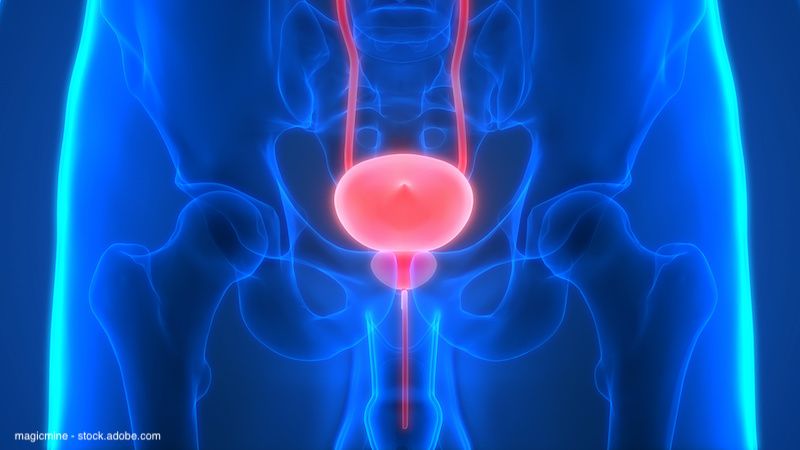




Bladder Cancer
Latest News
Advertisement
Latest Videos



CME Content


Advertisement
More News

"It is clearly the standard and it's the treatment of choice. When you have that, and it's very good, it's evidenced by the fact that none of the agents are compared against BCG because it sets such a high standard of effectiveness," says Sam S. Chang, MD, MBA.

Min Dong, PhD, discusses the main points of the presentation he gave at the 2022 Society of Urodynamics, Female Pelvic Medicine & Urogenital Reconstruction Winter Meeting, along with the potential impact of onabotulinumtoxinA (Botox) therapies on future urologic treatment.
“The fascinating thing is that we have so many new treatments that are now available to us,” says Leonard G. Gomella, MD, FACS.

“I think the audience would be encouraged to know that in the future, it seems like immunotherapy would become the standard of care,” says Shilpa Gupta, MD.

In this interview, senior author and scientific principal investigator Seth P. Lerner, MD, discusses the results of the OLYMPUS trial and what they mean for the management of this disease

"The future is bright for immunotherapy in bladder cancer," writes Michael S. Cookson, MD, MMHC.
“The complete response rates were 49%, which is quite impressive compared to historical controls,” says Shilpa Gupta, MD.

“Multidisciplinary discussion is best,” says Shawn Dason, MD, FRCSC.

In this interview, Kenneth M. Kernen, MD, describes his practice’s Jelmyto program and offers advice for urologists interested in implementing it in their practice.

The application for enfortumab vedotin is based on data from the phase 3 EV-301 trial.
The recommendation for EU approval was based on results from the CheckMate -274 trial.

The addition of lenvatinib to pembrolizumab did not improve overall survival in patients with advanced urothelial carcinoma.

“I think research is a very important tool,” says Padraic O’Malley, MD, MSc, FRCSC.

Shawn Dason, MD, discusses the findings and takeaways of the study, "How often does cisplatin ineligibility prevent patients from receiving adjuvant therapy following radical nephroureterectomy for upper tract urothelial carcinoma?"
“While Jelmyto is approved for both retrograde and antegrade instillation, the instructions for administration address retrograde instillation, and this is the first time that data on antegrade instillation has been documented in a clinical setting for this chemoablative therapy,” said Katie Murray, DO.
“We definitely don't have a clear standard,” says Shawn Dason, MD, FRCSC.
“These findings are an internal validation that the disparities we're seeing are real,” says Padraic O’Malley, MD, MSc, FRCSC.

At 3 months, 83% of patients (5/6) who received EG-70 achieved complete response, according to the treatment manufacturer, enGene.
“There are a few different approaches in perioperative medical chemotherapy or immunotherapy treatment, and it's unclear as to how we should consider all these different approaches,” says Shawn Dason, MD, FRCSC.

“We have to be more mindful and thoughtful about the fact that certain populations are underrepresented in clinical trials, and that’s likely due to a number of factors,” said co-author Padraic O’Malley, MD, MSc, FRCSC.
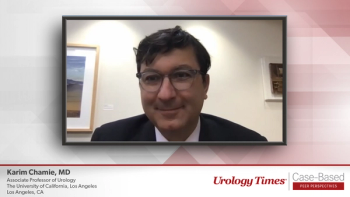
Karim Chamie, MD, describes what treatments might be on the horizon for muscle invasive bladder cancer and provides some clinical pearls to manage patients with MIBC.
A bladder cancer expert several ongoing clinical trials in the neoadjuvant and adjuvant setting.
An oncologist reviews the use of nivolumab in the adjuvant setting for treating high-risk muscle invasive bladder cancer and experience from his practice.
Dr. Karim Chamie details the available primary and adjuvant treatments for muscle invasive bladder cancer.
Karim Chamie, MD, presents the case of a 75-year-old woman with high-risk muscle invasive bladder cancer.
Advertisement
Advertisement
Trending on Urology Times
1
AI-generated profiles impersonate female urologists to market ED products online
2
Alternative BCG strains may help address ongoing supply challenges in NMIBC
3
Doublet or triplet? Urologists weighs in on mCSPC options
4
Pearls & Perspectives: Sexual Health and Intimacy in Midlife, With Karen Bigman, MBA
5